

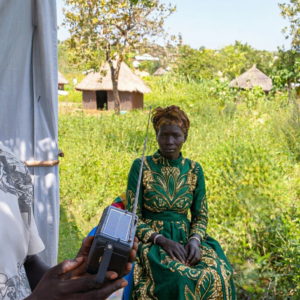
 Refugee families in Imvepi Refugee Settlement often face harsh weather conditions, including recurrent droughts that devastate crops and livelihoods. These climate-induced hardships frequently lead to school dropouts and poor attendance at Early Childhood Development (ECD) centers, as parents struggle to finance their children’s education. In mid-2024, it was estimated that over 700 children had dropped out across the settlement, with enrollment in some centers falling by as much as 14%.
To address this, Community Development Centre (CDC) Uganda supported Radio School to bring hope, education, and resilience to the community. Radio School is a project implemented by Allvox, a refugee youth-led nonprofit operating in Imvepi Refugee Settlement,
All Vox, Refugee-led Organisation – Imvepi Refugee Settlement
The RadioSchool project is transforming how refugee children learn and grow in the face of environmental and educational challenges. RadioSchool was designed to ensure that learning never stops, regardless of weather or financial constraints. By repurposing traditional classroom lessons into an audio learning programme, the Allvox team produced 25 lessons, each 35 minutes long, covering essential early childhood categories:
Morning Cycle
Mathematical Concepts
Oral Literacy and Language
Outdoor Activities and Free Choice
Snack Time and Goodbye
Since its start on January 16, 2025, RadioSchool has made significant strides in the community:
1,560 children reached through learning materials and audio programs
523 play materials produced by young refugees and caregivers
Over 60 community members have received the program on personal listening devices
5 megaphone radios have been used to distribute content, each reaching an estimated 150 households
22 parents have been equipped with climate-smart farming skills to improve family nutrition and income
Children in Imvepi hold play materials made by Allvox caregivers on October 2024
The impact of RadioSchool is best expressed through the parents who see changes in their children every day. One project beneficiary, Sadia Rejoice (community member/beneficiary), said:
“When I played it on my radio, my children were very, very happy… Even children who had not yet joined school also listened to the program and have now learned how to sing and dance.”
Another beneficiary, Harriet Yangi, also said:
“This programme has given my children a lot of wisdom and understanding… It is like security for my children because it keeps them at home and prevents them from engaging in harmful practices.”
CDC is committed to supporting the Radio School project by conducting more training for standby caregivers to strengthen community-led learning, distributing solar-powered speakers to ensure children can listen even without reliable electricity, and expanding kitchen garden training to help more families build climate resilience.
Leave a Reply